Your child just turned two. They're curious, active, and clearly understand much of what you say. But when it comes to talking, they only use a handful of words — maybe 10, maybe 15. Meanwhile, you've noticed other children the same age chatting in short sentences. You're wondering: is this normal? Should I be worried? Am I waiting too long to do something about it?
If this sounds familiar, you're not alone. Concerns about a child's speech around the second birthday are one of the most common reasons parents reach out to a speech-language pathologist. And the fact that you're asking questions means you're already doing something right — you're paying attention.
This article will walk you through what's typical at age 2, how to tell the difference between a late talker and a language delay, practical things you can do at home right now, and when it makes sense to seek professional support.
How Many Words Should a 2-Year-Old Have?
By 24 months, most children use approximately 50 or more words. These don't need to be perfectly clear — “ba” for ball, “nana” for banana, and “wa-wa” for water all count. What matters is that your child is using words consistently and meaningfully to communicate.
Between 24 and 30 months, most children also begin combining two words together: “more milk,” “daddy go,” “big truck.” This shift from single words to two-word combinations is one of the most significant language milestones in early childhood. It signals that your child is beginning to understand how language works — not just labelling things, but expressing ideas.
If your 2-year-old has significantly fewer than 50 words, or isn't yet combining words, it doesn't necessarily mean something is wrong. But it does suggest that a professional conversation may be worthwhile.
Typical Language Milestones Around Age 2
Late Talker vs. Language Delay — What's the Difference?
You may have heard the term “late talker” and wondered whether it applies to your child. In clinical terms, a late talker is a child between 18 and 30 months who has a limited expressive vocabulary but otherwise shows typical development. They understand language well, use gestures like pointing and waving, make eye contact, play appropriately with toys, and are socially engaged.
A language delay, on the other hand, may involve challenges beyond just a small vocabulary. A child with a language delay might have difficulty understanding what's said to them, show limited use of gestures, seem less interested in interacting with people, or have other developmental concerns alongside their speech.
The distinction matters because it can influence the type and urgency of support your child may benefit from. Some late talkers do catch up on their own. Children with a broader language delay are more likely to need professional support to build their communication skills. The challenge is that it can be difficult for parents to tell the difference on their own — which is exactly why a professional assessment can be so valuable.
Signs That Suggest More Than Just a Late Talker
While every child develops at their own pace, certain signs may suggest that what you're seeing goes beyond typical late talking. If any of the following apply to your child, speaking with a speech-language pathologist can help provide clarity.
When to Pay Closer Attention
If your child doesn’t follow basic requests like “give me the cup” or “come here” without gestures
If your child rarely points, waves, shakes their head, or uses body language to communicate
If your child was saying words but has stopped using them — regression is always worth discussing with a professional
If your child frequently has meltdowns because they can’t express what they want or need
If your child doesn’t seek out interaction with you or other children, or doesn’t respond when you call their name
If your child uses only a few consonant sounds and their babbling doesn’t vary much
Important: This checklist is for informational purposes only and does not replace a professional assessment. Individual results vary based on each child's unique needs.
What You Can Do at Home Right Now
While you're deciding whether to seek professional support, there are practical, evidence-informed strategies you can start using today. These approaches can support your child's language development in everyday moments — no special materials needed.
Narrate Your Daily Routines
Talk through what you're doing as you go about your day: “Now we're putting on your shoes. One shoe, two shoes. Let's go outside!” This gives your child a rich stream of language connected to real experiences they can see, touch, and feel. Keep your language simple and slightly above your child's current level.
Follow Their Lead
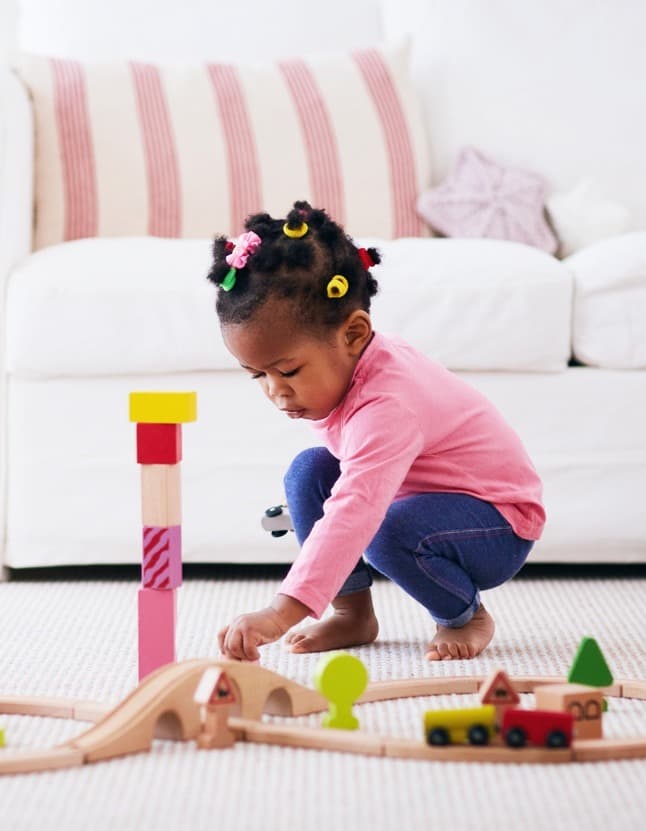
Instead of directing play, join in with whatever your child is interested in. If they're stacking blocks, sit beside them and talk about the blocks: “Up, up, up! So tall! Oh no, it fell down!” Children may learn language more readily when it's connected to something they're already motivated by.
Reduce Screen Time
Research consistently shows that passive screen exposure does not support language development in toddlers the way real human interaction does (Canadian Paediatric Society, 2023). The Canadian Paediatric Society recommends limiting screen time for children under 2. When screens are used, co-viewing with conversation is more beneficial than solo viewing.
Wait Expectantly
When your child wants something, resist the urge to immediately hand it over. Pause, make eye contact, and wait. Give them a few seconds to attempt a word, a sound, or a gesture. This creates natural opportunities for your child to communicate — and shows them that their attempts are noticed and valued.
Expand on What They Say
If your child says “car,” you can expand it: “Yes, a red car! The car is going fast.” If they say “more,” you can add: “More crackers? You want more crackers!” This technique — called expansion — models the next level of language without correcting or pressuring your child.
Does My 2-Year-Old Need Speech Therapy?
This is the question most parents actually want answered, and the honest response is that no article can settle it for your child — but you can tell whether it is worth finding out. There is no single word count that separates “needs therapy” from “doesn't.” What an SLP looks at is the whole picture: how much your child understands, how they compensate when words fail them, whether they are gaining skills or standing still, and how much frustration the gap is causing at home.
It also helps to separate two decisions that often get treated as one. Deciding to book an assessment is not the same as committing to a course of therapy. The assessment is how you find out. Sometimes the outcome is reassurance that your child is developing within the expected range and no therapy is recommended at all.
If your child is approaching or past their second birthday and has significantly fewer words than expected, seeking an assessment is a proactive step. You don't need to wait until you're certain there's a problem — an assessment can provide valuable clarity regardless of the outcome.
Consider reaching out if your child:
- Uses fewer than 50 words by age 2
- Is not combining two words by 24–30 months
- Seems to understand much less than other children their age
- Has lost words they previously used
- Shows frustration when trying to communicate
In Ontario, you do not need a doctor's referral to see a private speech-language pathologist. You can contact a CASLPO-registered SLP directly and schedule a free consultation to discuss your concerns.
What Happens During an Assessment?
If you're unfamiliar with what a speech therapy assessment looks like for a 2-year-old, here's what to expect. The process is gentle, play-based, and designed to feel natural for your child.
During an early intervention assessment, an SLP will observe how your child communicates — their words, sounds, gestures, and how they interact with you and with toys. The SLP will ask you about your child's developmental history, what they understand, how they express themselves at home, and any concerns you have.
Based on this information, the SLP will discuss their observations, whether therapy may be helpful, and what kind of support might look like. For many children at this age, therapy is play-based, happens in the home, and heavily involves parent coaching — teaching you strategies to support your child's language throughout the day, not just during therapy sessions.
An assessment is never something to fear. At worst, you gain reassurance that your child is on track. At its most helpful, it gives your child access to support during a period that is widely considered important for language development.
The Case Against “Wait and See”
Many parents are told by well-meaning family members — and sometimes even healthcare providers — to “just wait” and see if their child catches up. While this advice comes from a place of reassurance, the research paints a more nuanced picture.
Studies show that while some late talkers do catch up without intervention, a significant proportion — roughly 20 to 30 percent — continue to experience language difficulties into preschool and beyond (Rescorla, 2011). These children may face challenges with literacy, social communication, and academic performance. The difficulty is that there is no reliable way to predict at age 2 which children will catch up and which will not.
What we do know is that early interventionduring the first three years of life can make a meaningful difference. The brain is highly adaptable during this period, forming a remarkable number of new neural connections. Therapy during this window may not only help address the current delay — it may also take advantage of the brain's natural readiness to learn language.
There is very little downside to seeking an assessment. The potential cost of waiting is time — time during a period when your child's brain may be especially receptive to language learning.
Getting Help in Durham Region
If you're a parent in Durham Region, Functional Communication offers in-home speech therapy for children ages 1 to 7. We come to your home in Pickering, Ajax, Whitby, Oshawa, Courtice, and Brooklin— which means your child learns in the environment where they're most comfortable.
We offer a free 15-minute phone consultation to discuss your concerns. No referral is needed, and many extended health insurance plans cover private speech therapy — we recommend checking your specific plan for details. The consultation is simply a conversation — there's no pressure, no commitment, and no obligation.
A Note for Parents Who Feel They Waited Too Long
If your child is past their second birthday and you're reading this wondering whether you should have acted sooner, please know this: you have not missed your chance. The window for language intervention does not close at any particular age. Children at 2, 3, 4, and beyond can all be supported in their communication development.
What matters most is what you do from this point forward. The fact that you're educating yourself and considering your child's needs is a sign of good parenting — not a sign of failure. Every child's journey is different, and every starting point is valid. If you have concerns, reaching out today is always the right time.
Professional Disclaimer:This article is for educational purposes and does not constitute professional advice or a clinical assessment. Individual results vary based on each child's unique needs and circumstances. A free consultation does not constitute a clinical assessment or diagnosis. For personalized guidance, please consult with a qualified speech-language pathologist.
Sneha Fonseka is a registered speech-language pathologist (CASLPO Reg. #7608) providing in-home speech therapy across Durham Region.
Common Questions
Does my 2-year-old need speech therapy?
There is no single threshold that decides this, but a few markers are worth paying attention to at age 2. Most children use around 50 or more words by 24 months and begin combining two words between 24 and 30 months. If your child is well below that, has lost words they previously used, is difficult to understand, or seems frustrated trying to communicate, an assessment with a speech-language pathologist can help you find out whether therapy would be useful. An assessment is not a commitment to therapy — it is how you get a clear answer instead of guessing. In Ontario you do not need a physician's referral to book one.
Is it normal for a 2-year-old to only say 10 words?
By 24 months, most children use around 50 or more words, so a vocabulary of only 10 words may indicate a delay worth exploring. However, every child develops differently. If your child understands language well, uses gestures, and is engaged socially, they may simply be a late talker. A speech-language pathologist can help you understand whether support would be beneficial.
Will my child just grow out of a speech delay?
Some children who are late talkers do catch up on their own by age 3 or 4. However, research suggests that roughly 20–30% of late talkers continue to have language difficulties without support. There is no reliable way to predict which children will catch up and which won't — which is why an early assessment is always recommended. It provides clarity and, if needed, a head start on support.
Do boys talk later than girls?
On average, boys do tend to reach early language milestones slightly later than girls. However, this small difference does not mean that a significant speech delay in a boy should be dismissed. If your son has far fewer words than expected for his age, an assessment with a speech-language pathologist is still recommended regardless of gender.
How many words should a 2-year-old say?
By 24 months, most children use approximately 50 or more words and are beginning to put two words together (e.g., 'more milk,' 'daddy go'). By 30 months, vocabulary typically grows rapidly. If your child is well below these ranges, a speech-language pathologist can assess whether support may be helpful.